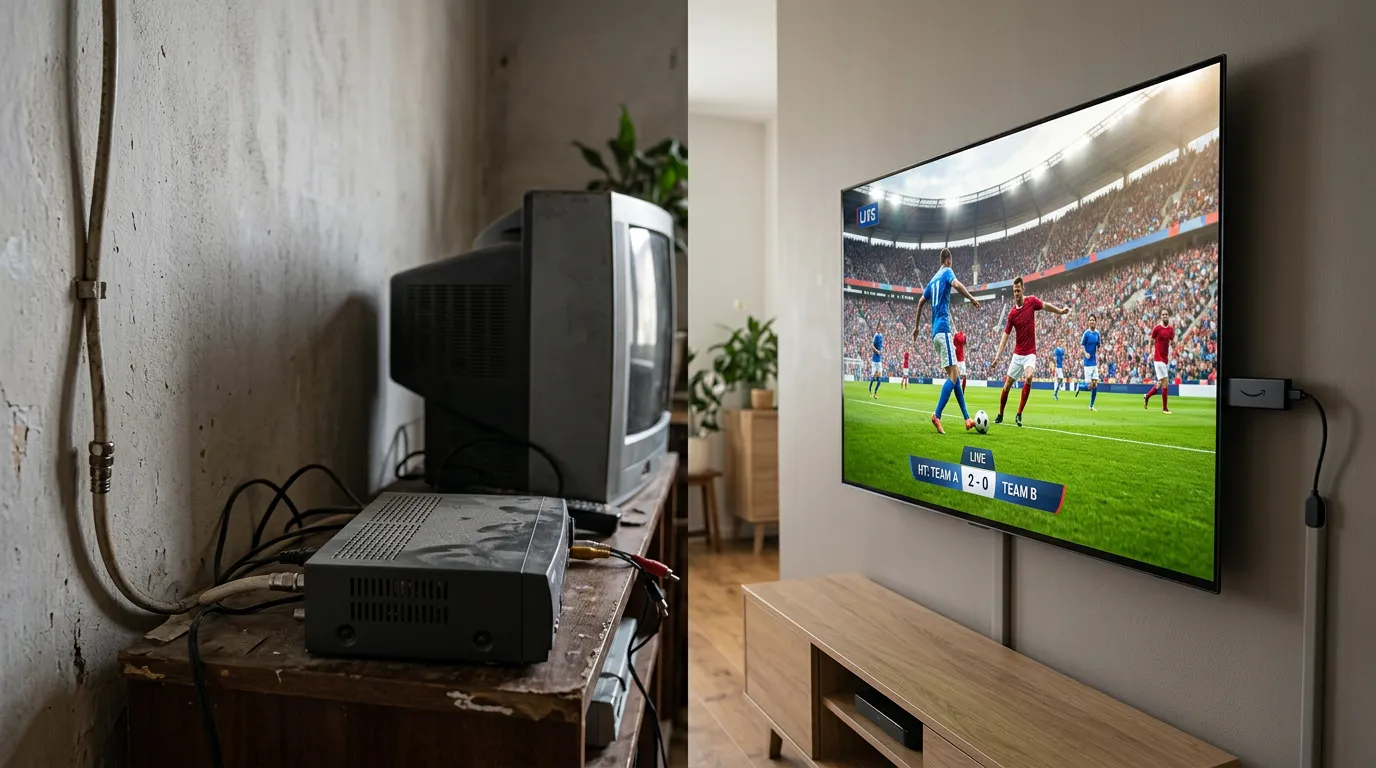
Cable TV in the UK is expensive, inflexible, and increasingly hard to justify. You pay for channels you never watch, locked into a contract that punishes you for leaving, watching prices creep up every year whether you like it or not. And yet millions of UK households are still on cable bundles — not because they are happy with the deal, but because switching feels complicated.
It doesn’t have to be. IPTV vs Cable TV UK is one of the clearest comparisons in modern television. One is built on physical infrastructure, rigid packages, and long-term lock-in. The other runs over the broadband you already have, costs a fraction of the price, and gives you more content on more devices with no contract and no commitment.
This guide breaks it all down honestly. What cable gives you, what IPTV gives you instead, where each one has a genuine edge, and whether cutting the cord is the right move for your household in 2026.
What Is Cable TV in the UK and Who Still Offers It?
In the UK, ‘cable TV’ primarily means Virgin Media — the only major provider still operating a cable television network across large portions of the country. Sky is technically satellite rather than cable. BT and other providers use either satellite or IPTV-based infrastructure themselves.
Virgin Media delivers television over physical coaxial cables that run from a central hub to your property. This requires installation, works only in areas where Virgin Media’s cable network exists, and comes bundled with broadband as standard. It is a traditional pay TV model — you choose a package tier, sign an 18-month contract, and pay a monthly bill that increases annually.
For the majority of UK households, cable TV means a Virgin Media bundle costing between £60 and £100 per month depending on package level, sports add-ons, and whether you are still on an introductory rate or have moved onto the standard price after your deal expired.
What Cable TV Does Well — the Honest Version
Cable TV is not without genuine strengths. Any fair comparison acknowledges what it delivers properly.
Physical Signal Reliability
Cable TV’s signal comes through a physical cable to your home — it does not depend on your broadband connection or internet speed. In areas with poor broadband infrastructure, or during peak internet usage periods, cable maintains consistent signal quality that IPTV cannot guarantee if your connection is weak. For households in areas with unreliable broadband, cable’s physical infrastructure is a genuine advantage.
Simple Plug-and-Play Experience
The Virgin Media V6 box connects to your TV, you pick up the remote, and you watch television. No app to configure, no M3U link to enter, no EPG URL to paste in. For less technically confident viewers — older family members in particular — the simplicity of a dedicated set-top box with a single remote is a meaningful practical advantage that IPTV’s flexibility cannot always replicate as smoothly.
One Bill, One Provider
Broadband, TV, sometimes phone — all in one monthly payment from one provider. For households that value administrative simplicity above all else, the single-bill convenience of a cable bundle has real appeal. IPTV requires you to manage your broadband and IPTV subscription separately, which is trivially simple for most people but represents a change from the all-in-one bundle model.
Where Cable TV Fails UK Viewers in 2026
The frustrations with cable TV are well-known to anyone who has been a customer for more than a year. Here is where it consistently falls short.
The Price Is Too High and Keeps Rising
The average UK cable TV bundle has increased in price every year for the past decade. These are not small increases — they are often inflation-linked plus an additional percentage, built into the contract terms in ways that many customers do not notice until the first price rise letter arrives. The introductory rate is always the best rate. The standard rate is almost always higher than you expected when you signed up.
The Contract Locks You In
Eighteen months is a long time to be locked into a television service. If your circumstances change — you move house, your income changes, the service quality deteriorates, a better option appears — getting out of a cable contract costs real money. Early termination fees are not symbolic. They are designed to make leaving feel expensive enough that most customers simply stay and keep paying.
You Pay for Channels You Never Watch
Cable TV packages are tiered bundles. To get the channels you actually want, you buy a tier that includes dozens of channels you have never opened. There is no meaningful way to customise a cable TV package around your actual viewing habits. You pay for the bundle, and the bundle includes whatever the provider decided to put in it.
It Only Works Where the Cable Reaches
Virgin Media’s cable network does not cover the entire UK. In areas without coverage, cable TV is simply not available. Even within coverage areas, flats, rented properties, and certain building types can face installation complications that make the service impractical to access.
What IPTV Gives You That Cable Cannot
Now the other side of the comparison — and this is where IPTV providers in UK consistently leave cable behind on almost every measure that UK viewers actually care about.
Every Channel You Want — and More
A quality IPTV service includes every major UK broadcaster live — BBC One, BBC Two, ITV, Channel 4, Channel 5 — plus Sky Sports, TNT Sports, and hundreds of international and specialist channels. In many cases the total channel count exceeds what any cable TV package offers, at a monthly cost that is a fraction of the cable equivalent. The content breadth available through IPTV in 2026 is genuinely remarkable compared to what cable TV packages contain at any price point.
No Contract, No Lock-In, No Exit Fees
Month-to-month. Cancel anytime. No early termination fees. No phone call to retentions. No negotiation. If the service is not right, you leave. This is not a minor feature — it is a fundamentally different power dynamic between the viewer and the service. IPTV providers keep your business by being good. Cable providers keep your business by making leaving expensive.
Every Device You Already Own
Firestick, smart TV, Android box, laptop, tablet, phone — IPTV works across all of them, often simultaneously. Cable TV is tied to the physical location of the set-top box and the cable outlet in your wall. IPTV follows you around the house, to the garden, on the commute, and on holiday — anywhere your broadband or mobile data reaches.
Dramatically Lower Cost
A quality IPTV service covering everything in a mid-tier cable TV package typically costs between £10 and £20 per month. A comparable Virgin Media cable bundle runs £70–90 per month. Over an 18-month contract period, that difference represents a saving of between £900 and £1,200 — for the same television content, on more devices, with no contract and no commitment.
For a full picture of what IPTV providers in the UK offer, see our IPTV providers in UK beginner guide and our how IPTV works in the UK guide. For subscription options, see our IPTV subscription UK guide.
At this point, if you are seriously considering cutting the cable cord, the next question is which IPTV service to try first. Golden TV is the one that keeps coming up in UK IPTV communities for exactly the qualities cable TV fails to deliver: stable streams during live sports, a complete UK channel lineup including BBC, ITV, and all the sports channels, and support that actually picks up when you need it. No contract. No engineer. No annual price rise letter. Message the team on WhatsApp and you could be watching on your Firestick or smart TV within the hour.

*Recommended based on user feedback from UK IPTV communities. We do not operate or sell IPTV services directly.
Is IPTV Reliable Enough to Replace Cable TV Completely?
This is the question that holds most cable TV customers back from switching. And it deserves an honest answer rather than a sales pitch.
The reliability of IPTV depends on two things: the quality of your broadband connection and the quality of the IPTV provider. A household with a stable 25 Mbps broadband connection and a reputable IPTV service will experience stream quality that is indistinguishable from cable TV during normal viewing. The picture is HD, the channels load instantly, and the EPG works exactly as you would expect.
Where IPTV can be less reliable is during periods of peak broadband congestion — particularly on heavy sports evenings when your local broadband infrastructure is under pressure from many simultaneous users. A quality IPTV provider with distributed server infrastructure handles this better than a budget service. But a wired ethernet connection rather than WiFi removes the most common source of variability entirely.
For the vast majority of UK households with modern broadband — which in 2026 means the overwhelming majority of the country — IPTV is a completely reliable replacement for cable TV. The edge cases are narrow and becoming narrower every year as UK broadband infrastructure improves.
Frequently Asked Questions – IPTV vs Cable TV UK
Is IPTV better than cable TV in the UK?
For most UK households in 2026, yes. IPTV offers more channels, more devices, no contract, and dramatically lower monthly costs. The only scenarios where cable TV genuinely wins are households with very poor broadband connections, or viewers who specifically value the simplicity of a dedicated set-top box and a single provider bill above all else.
How much does IPTV cost compared to cable TV in the UK?
A quality IPTV service covering the same content as a mid-tier cable TV package typically costs £10–20 per month. A comparable Virgin Media cable bundle runs £70–90 per month after introductory rates expire. The saving over an 18-month period ranges from £900 to £1,200 for equivalent content.
Do I need cable broadband to use IPTV?
No. IPTV works over any broadband connection — fibre, ADSL, or even a strong mobile data connection. You do not need Virgin Media broadband or any specific provider. A minimum of 15 Mbps download speed is recommended for stable HD streaming, and 25 Mbps for 4K content.
Can I get Sky Sports and TNT Sports through IPTV instead of cable?
Yes. A comprehensive IPTV service includes Sky Sports and TNT Sports channels live — the same content available through cable TV packages — at a fraction of the combined monthly cost. This is one of the most common reasons UK sports fans leave cable TV for IPTV.
Is cable TV being switched off in the UK?
Virgin Media’s cable TV network is not being switched off in the near future, but the UK’s long-term broadcasting strategy is moving toward IPTV-based delivery. The government has been discussing a future ‘digital switchover’ from terrestrial and cable broadcasting to internet-based delivery, with timelines potentially beginning in the 2030s. Cable TV will continue to serve UK households for years to come, but the direction of travel in UK broadcasting policy is clearly toward IPTV.
What happens to my channels if I switch from cable to IPTV?
In terms of content, nothing changes. A quality IPTV service includes every channel available in standard and mid-tier cable TV packages. In terms of the viewing interface — your set-top box, the EPG layout, the remote — these are specific to your cable provider and are replaced by an IPTV player app. The adjustment period for most households is less than a day.
Can I use IPTV in a rented flat or property?
Yes. This is one of IPTV’s clearest advantages over cable TV. IPTV requires no installation, no engineer visit, and no physical alterations to the property. It works through your existing broadband connection on any compatible device. Renters who cannot install a cable or satellite dish have full access to the complete IPTV channel lineup without any landlord permission required.
Final Verdict – Is It Time to Cut the Cable?
If your cable TV contract is ending, the answer is almost certainly yes. The renewal price will be higher than your current rate, and IPTV offers the same content for a fraction of the monthly cost with none of the contractual constraints.
If you are mid-contract, the calculation is whether the saving from switching outweighs the exit fee and remaining contract value. For contracts with less than six months remaining, switching often saves money immediately. For longer remaining terms, use the time to trial an IPTV service properly — so you are ready to switch the moment you are free to do so without penalty.
Cable TV was the right answer for UK households for thirty years. In 2026, IPTV is the right answer for most of them. The content is the same. The cost is dramatically less. And the flexibility is incomparably better.
Cable TV had a good run. But in 2026, the combination of rising costs, rigid contracts, and inferior flexibility makes it a difficult choice to justify for most UK households. IPTV — and specifically Golden TV — gives you more channels, more flexibility, better value, and the freedom to cancel the moment it stops being right for you. That is what television should feel like. Get in touch on WhatsApp and see what switching actually looks like in practice.
Disclosure: This site recommends third-party services based on user feedback and research. We do not operate, sell, or provide IPTV services directly. All trademarks belong to their respective owners.